Sergei A. Klioner
Lohrmann Observatory, Technische Universität Dresden, 01062 Dresden, Germany
The time ephemerides for each body represent the time transformation
between the coordinate time TCX of the local GCRS-like relativistic
reference system of the corresponding body X and the coordinate time TCB of the BCRS.
The original GCRS (Geocentric Celestial Reference System) was defined
for the Earth and adopted by the IAU back in 2000. For the Moon, the
GCRS-like coordinate system is called LCRS (Lunar Celestial Reference
System) and it was recommended by the IAU Resolution II of 2024 "to
establish a standard Lunar Celestial Reference System (LCRS) and Lunar
Coordinate Time
(TCL)": https://iau.org/Iau/Publications/List-of-Resolutions.
For the Moon then, the time ephemeris published here represents a
numerical transformation between TCL and TCB evaluated in the center
of gravity of the Moon.
As it was always intended for the GCRS and as the cited IAU Resolution
states, similar GCRS-like relativistic reference systems and
coordinate times can be defined for any body of the Solar System. This
framework is assumed here. Analogous to TCG and TCL, the numerical transformations
between between the coordinate times TCX of other solar system bodies are computed.
The notation used for these coordinate time are given in the tables below.
The physical background of the relativistic reference systems on the
example of BCRS and GCRS can be found
in (Soffel,
Klioner, Petit et al. 2003) and references therein.
The description of the formulas used in the calculations of the time
ephemerides are published
in (Klioner,
Gerlach, Soffel, 2010, Section 6) or, in much more details, in the
publicly accessible Technical
Note (Klioner,
2025) discussing the time framework of Gaia. In particular,
two functions for each body are given here:
https://www.imcce.fr/recherche/equipes/asd/inpop/download19a
In particular, the short version of INPOP19a was used here which is valid for approximately 200 years.
Since the export version of the INPOP19a ephemeris was used, the
overall accuracy of the time ephemerides published here are somewhat
lower than that of the time ephemerides that could be computed
directly by the ephemeris providers using their numerical integration
framework and dynamical models. This is being done already now for the
transformation between TCB (or TT) and TCB (or TDB) for the
Earth. Those latter time ephemerides are part of the standard INPOP
delivery.
Nevertheless, to demonstrate the accuracy of the time ephemerides
provided here the transformation between TCG and TCB at the geocenter
was computed using our framework and is also published here. One can
show that the differences between the TCG ephemeris at the geocenter
published here and that published as a part of INPOP19a is
6.2×10⁻¹⁸ in the linear trend and a non-linear
(quasi-periodic) deviation of about 0.15 nanosecond within the
validity period of about 200 years. The difference most probably
originates from the extended dynamical models (asteroids and Kuiper
belt objects) used in INPOP19a and missing in the framework used here.
Numerical noise in the time ephemerides published here is estimated
at the level of a few picoseconds.
The time ephemerides are represented via Chebyshev polynomials as it
is done for all solar system ephemerides. The ASCII files below are in
the same standard format that is used e.g. by the INPOP team.
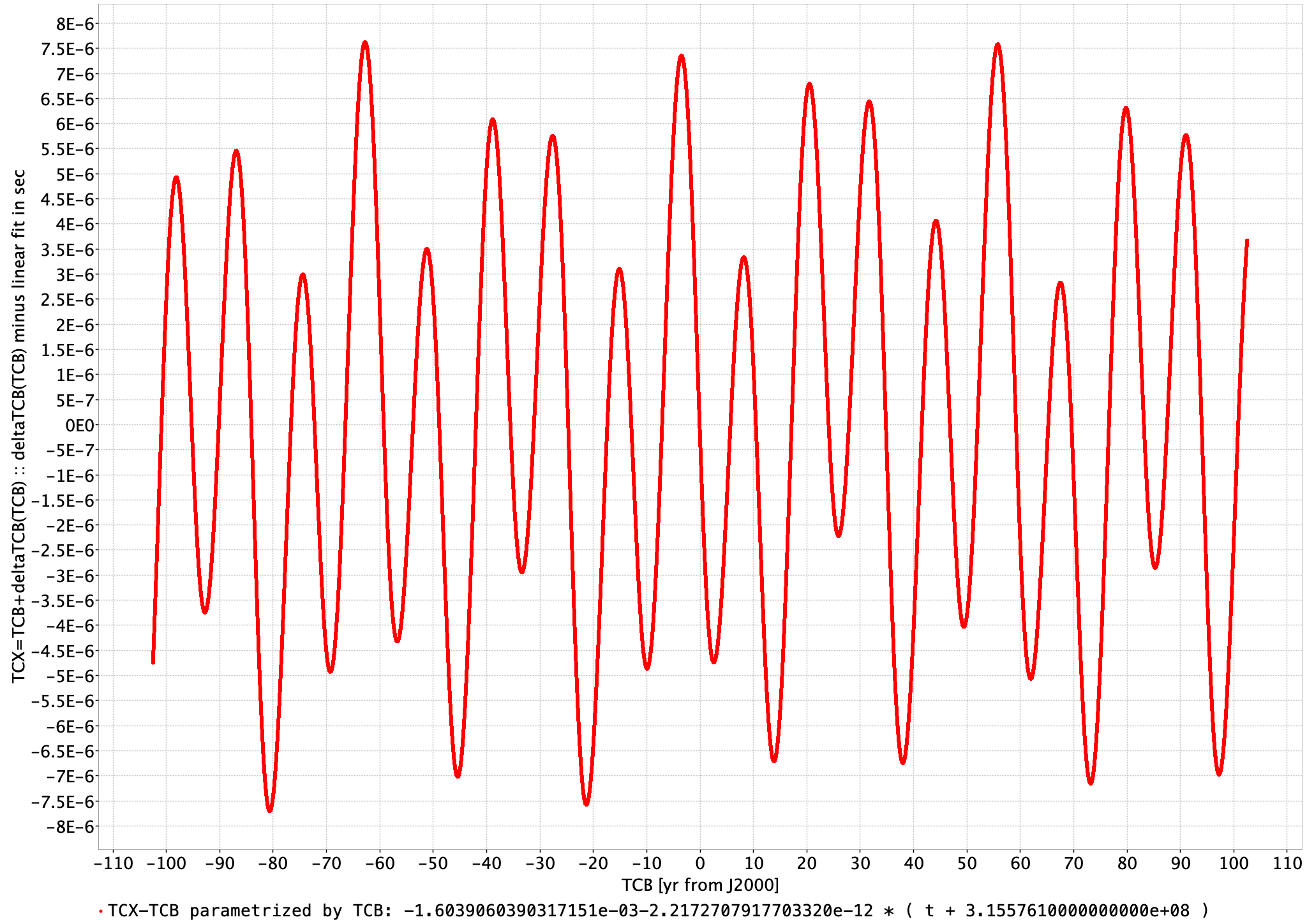
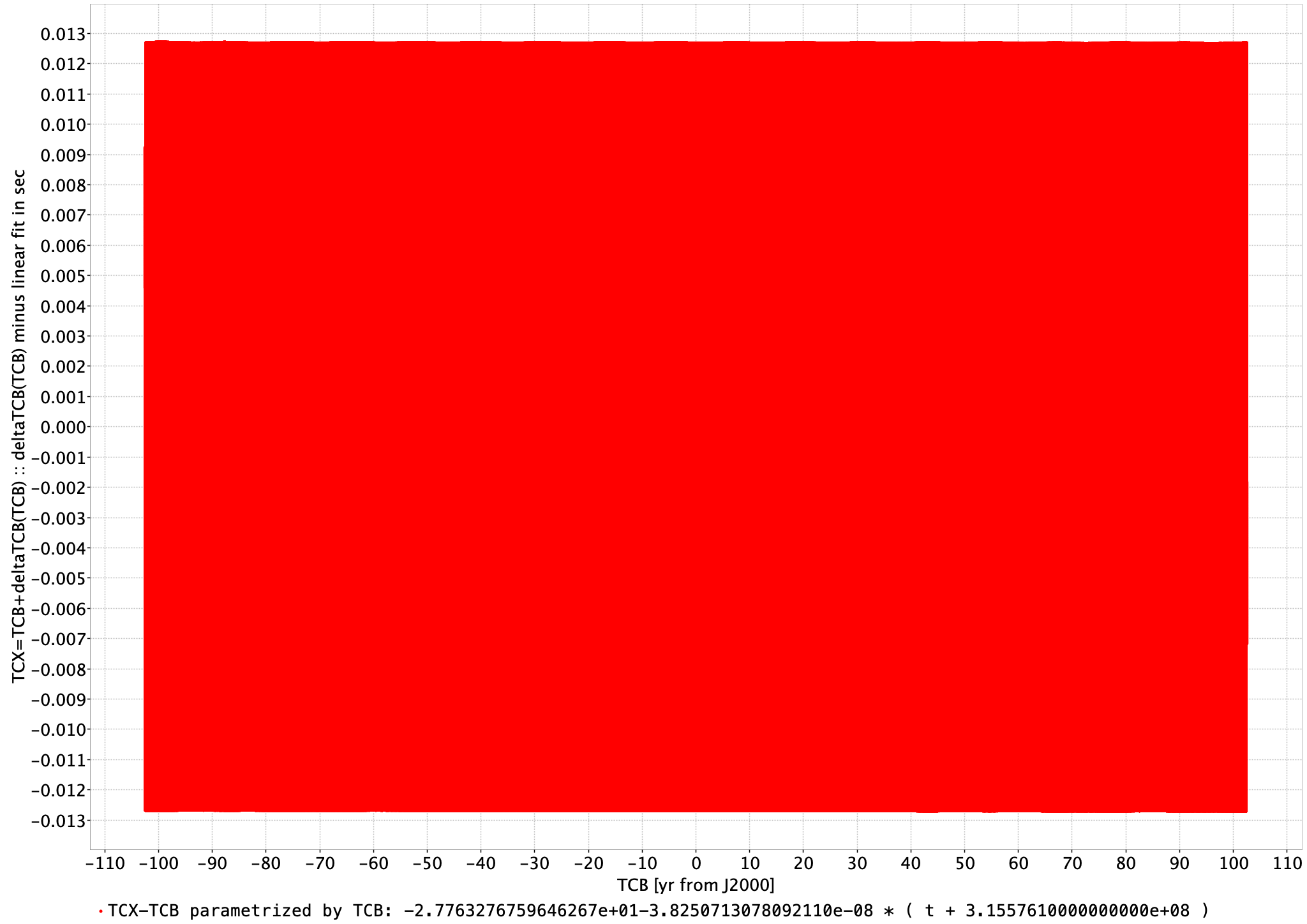
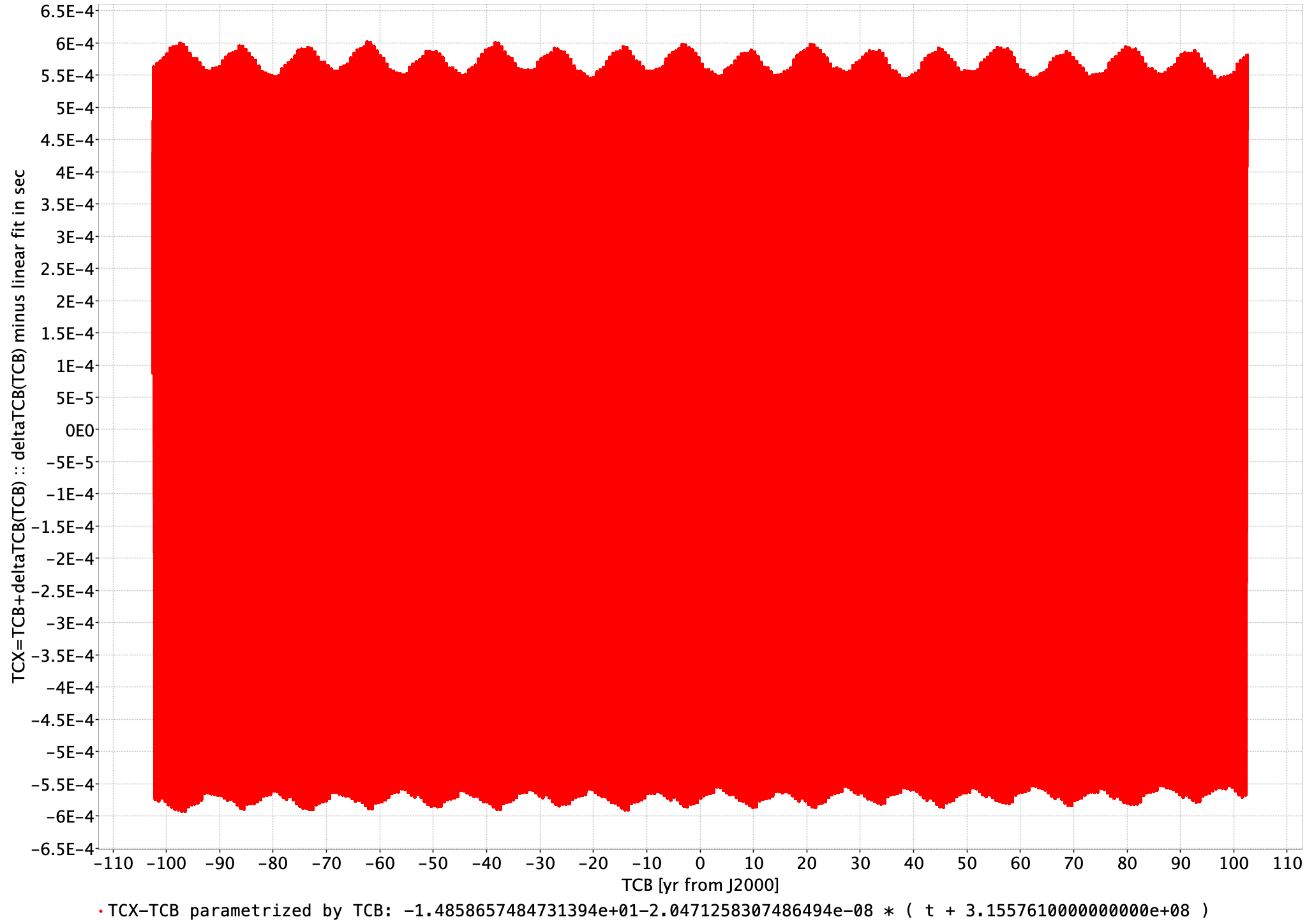
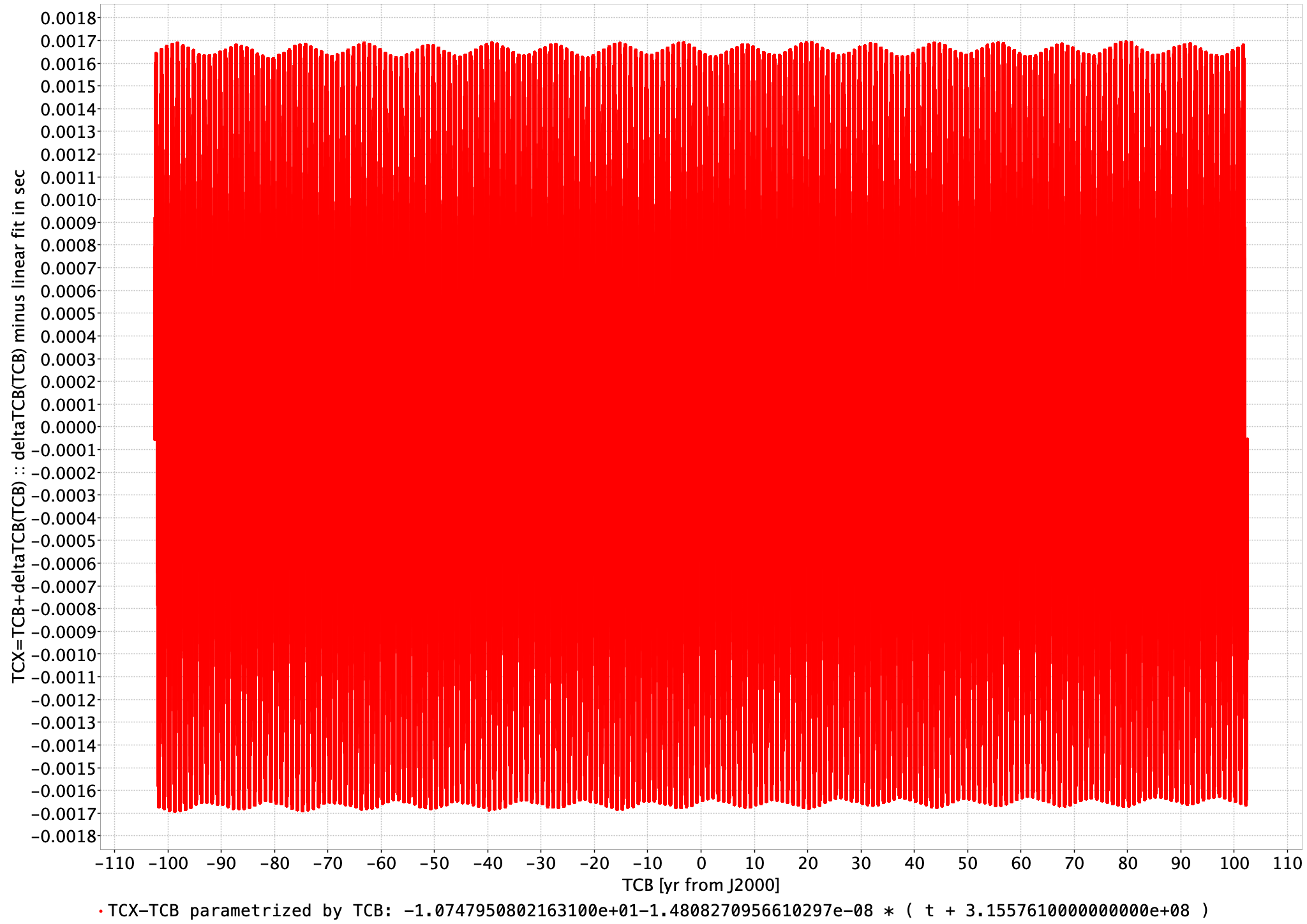
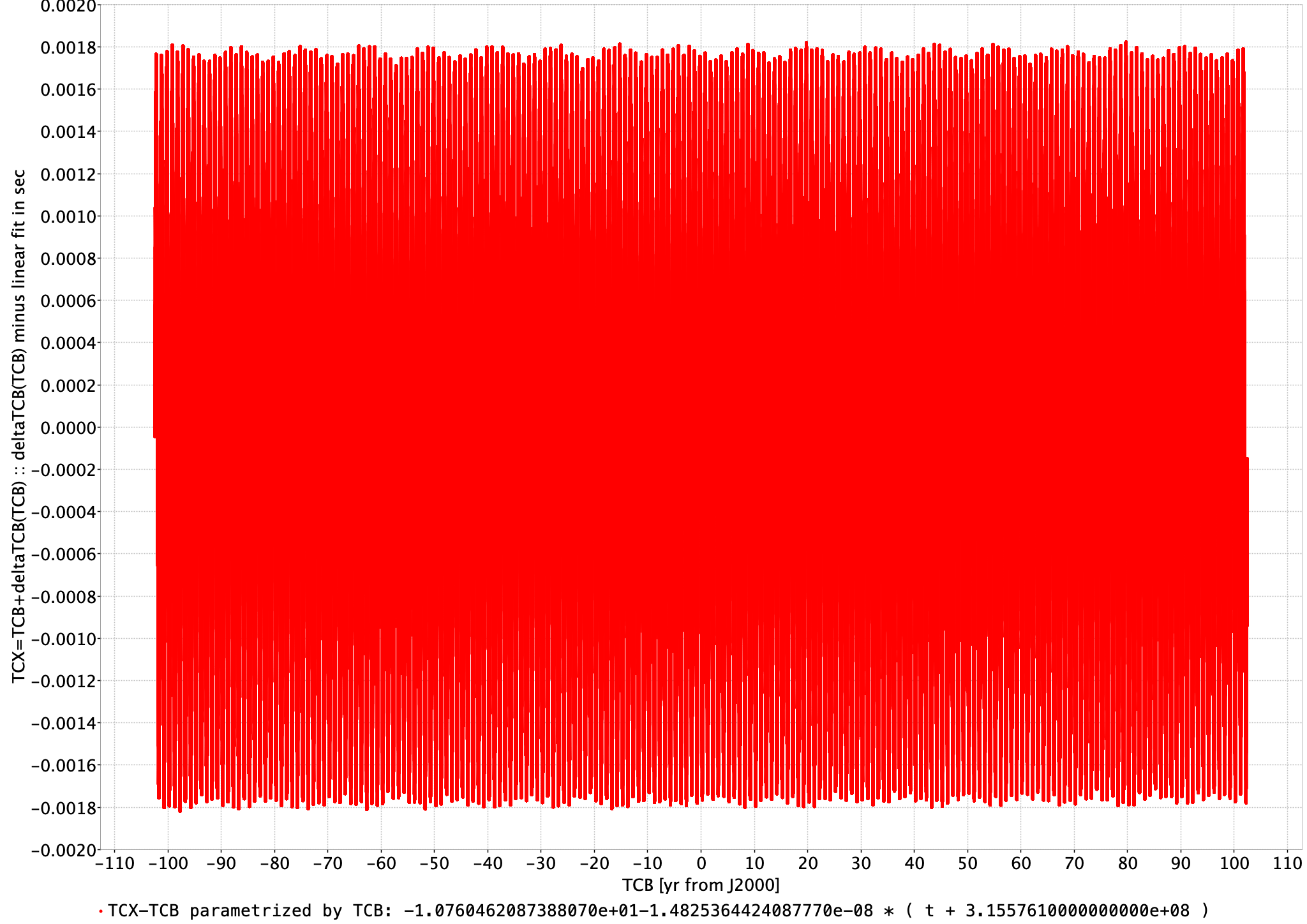
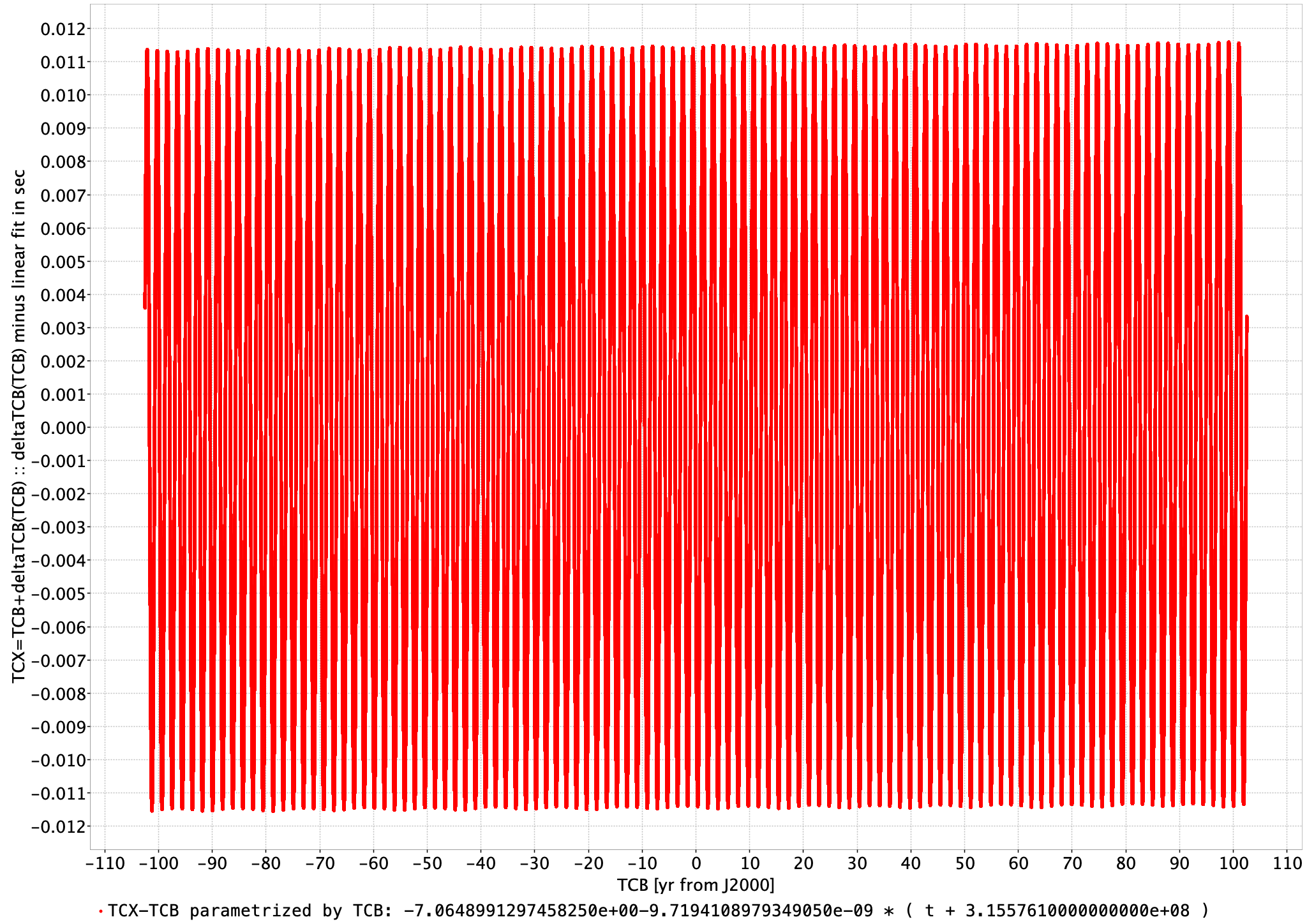
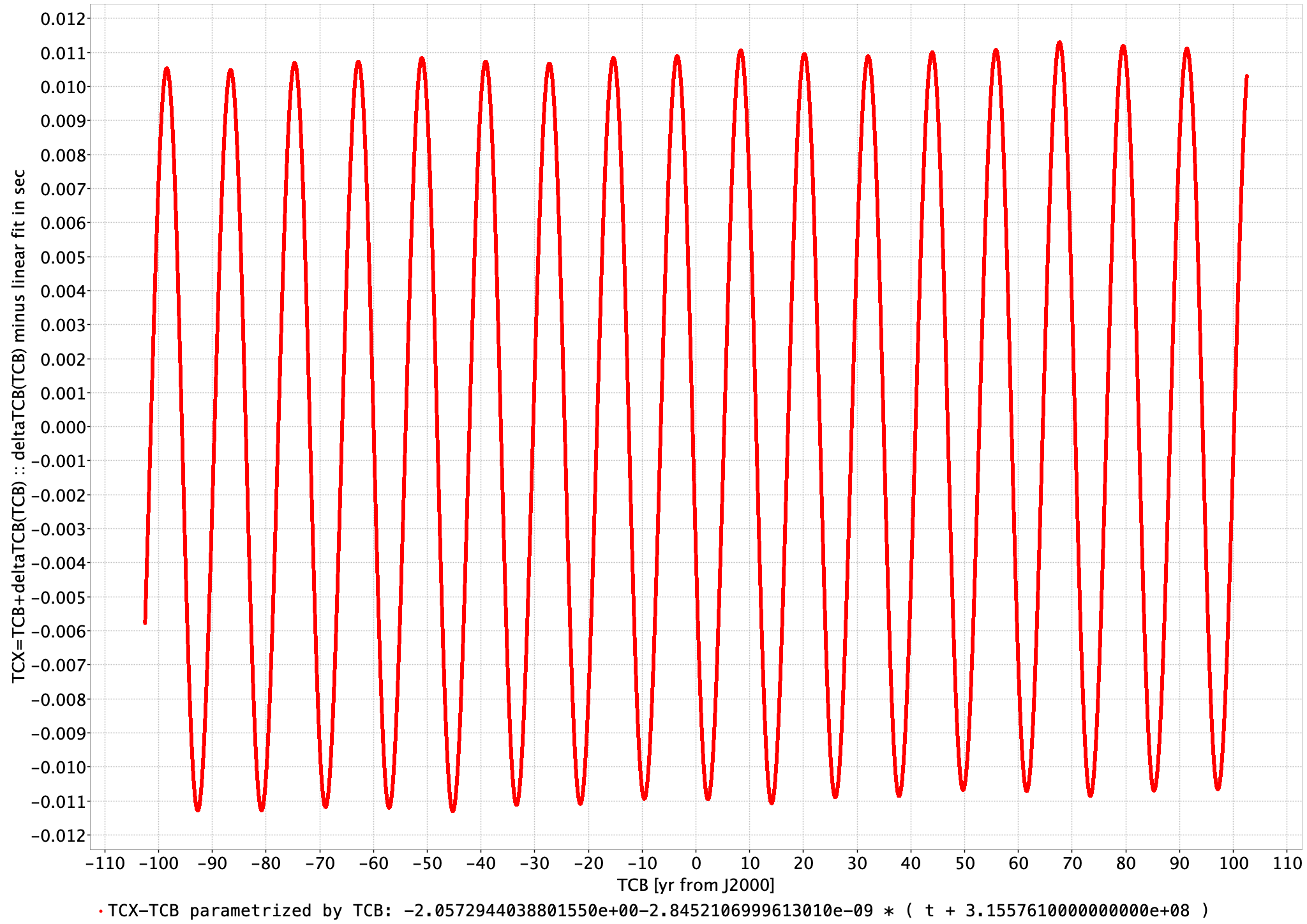
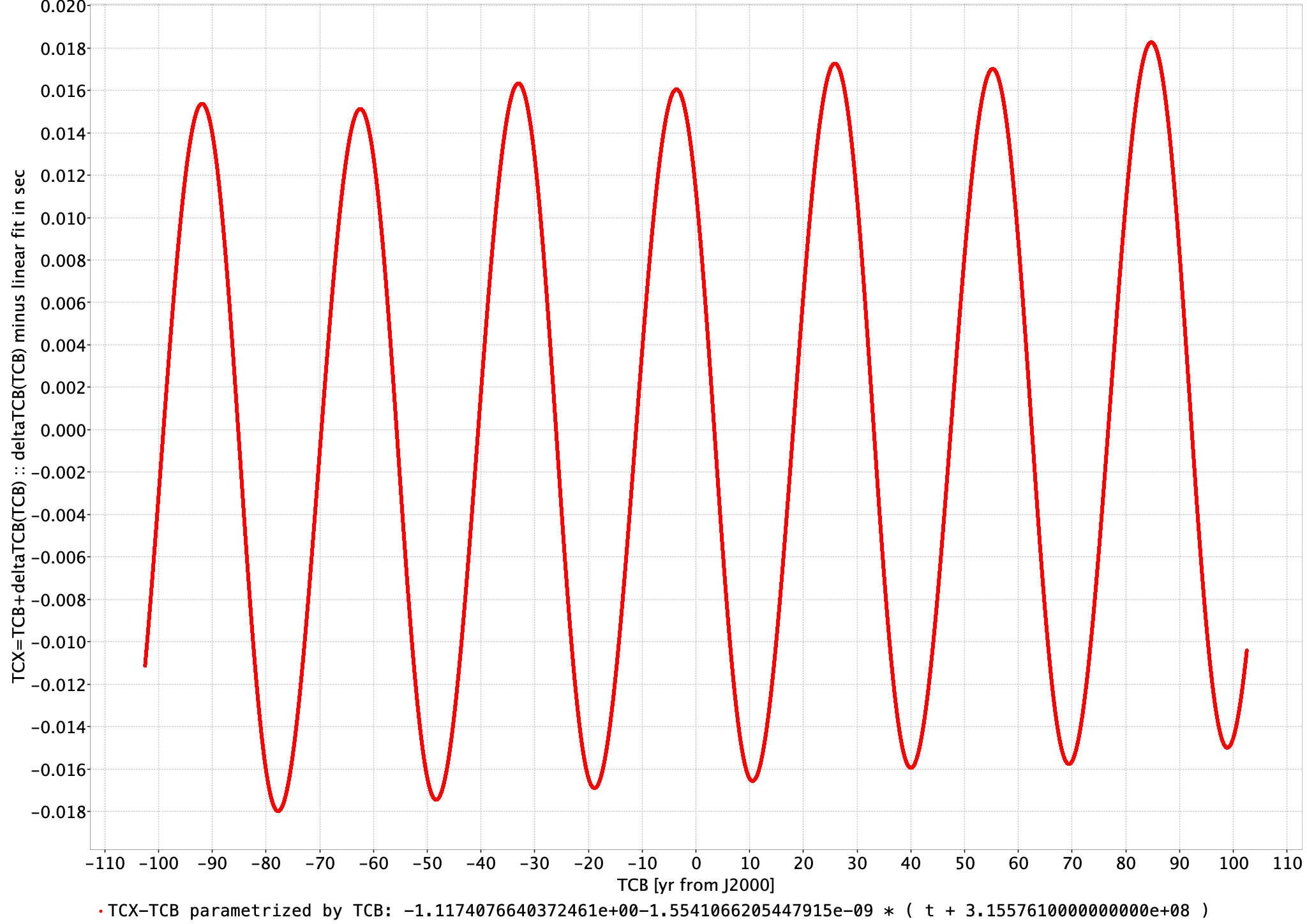
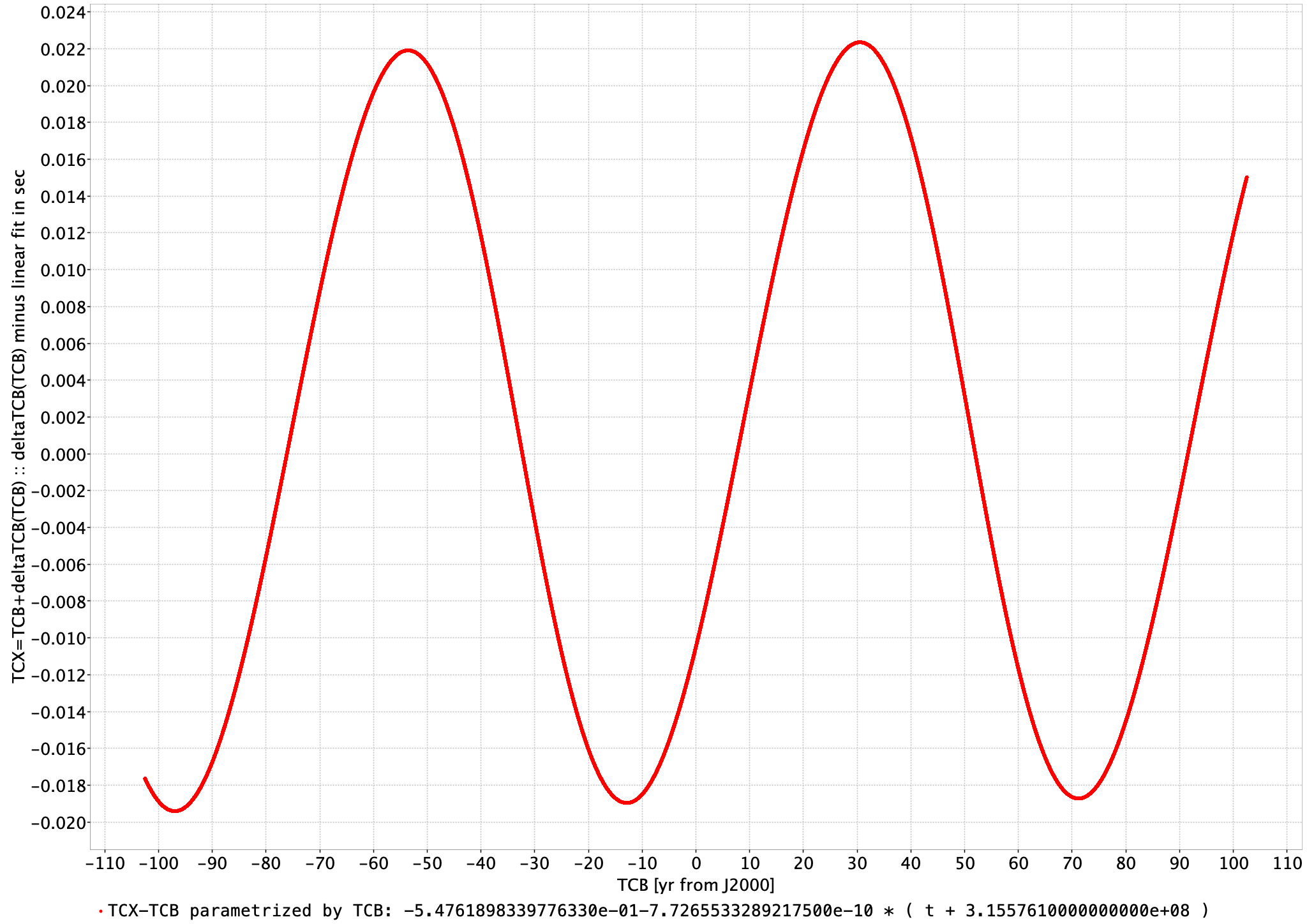
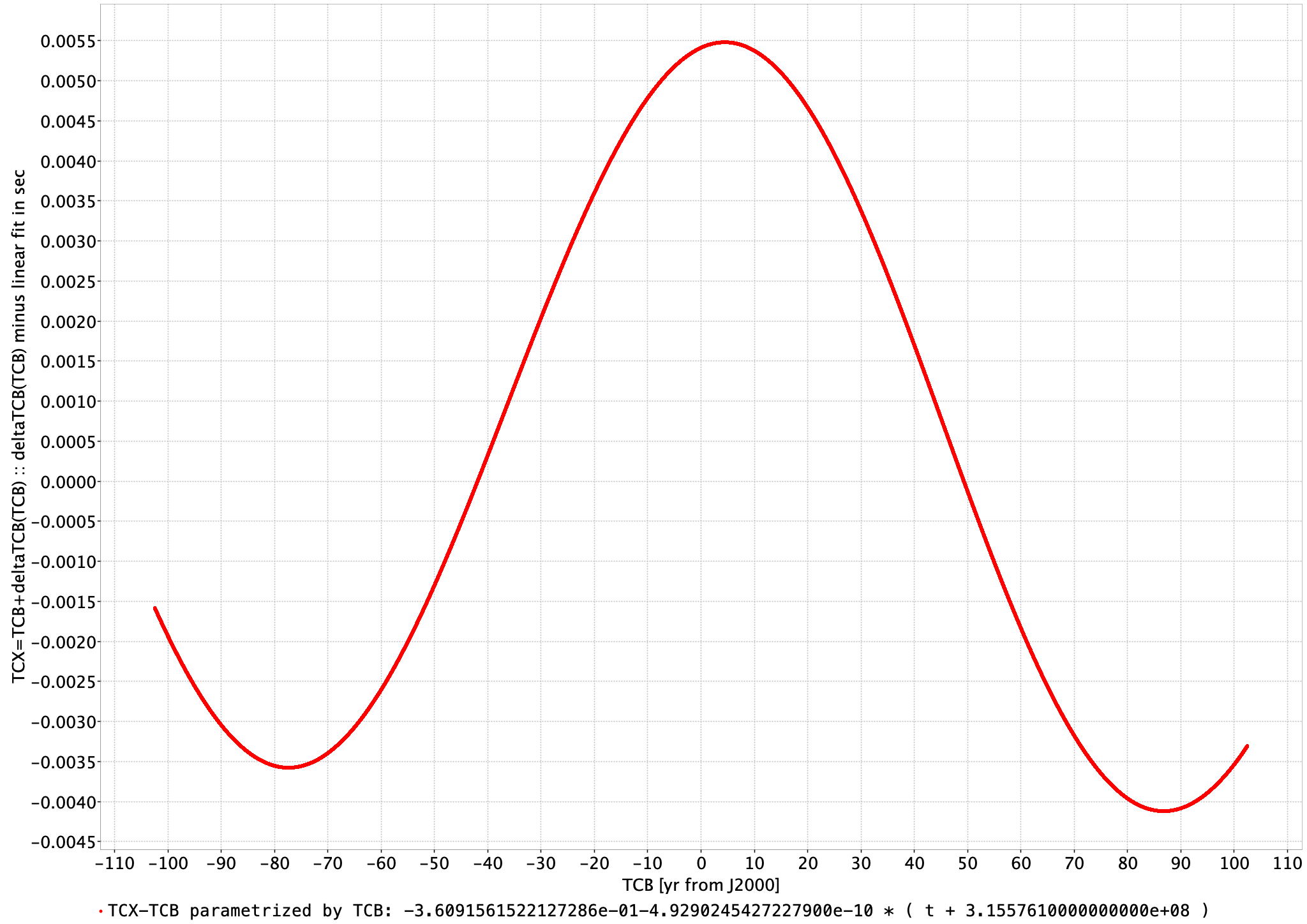
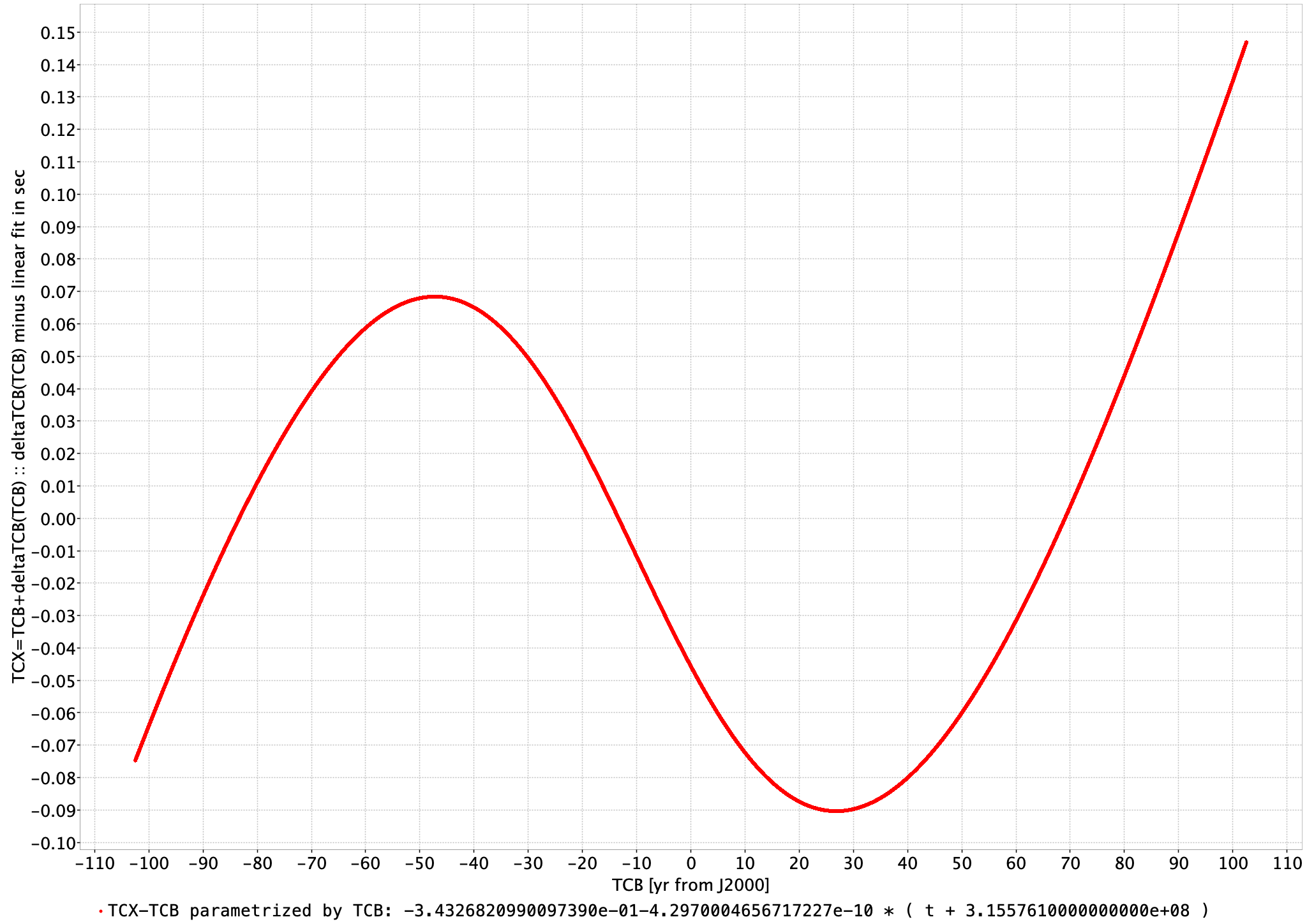
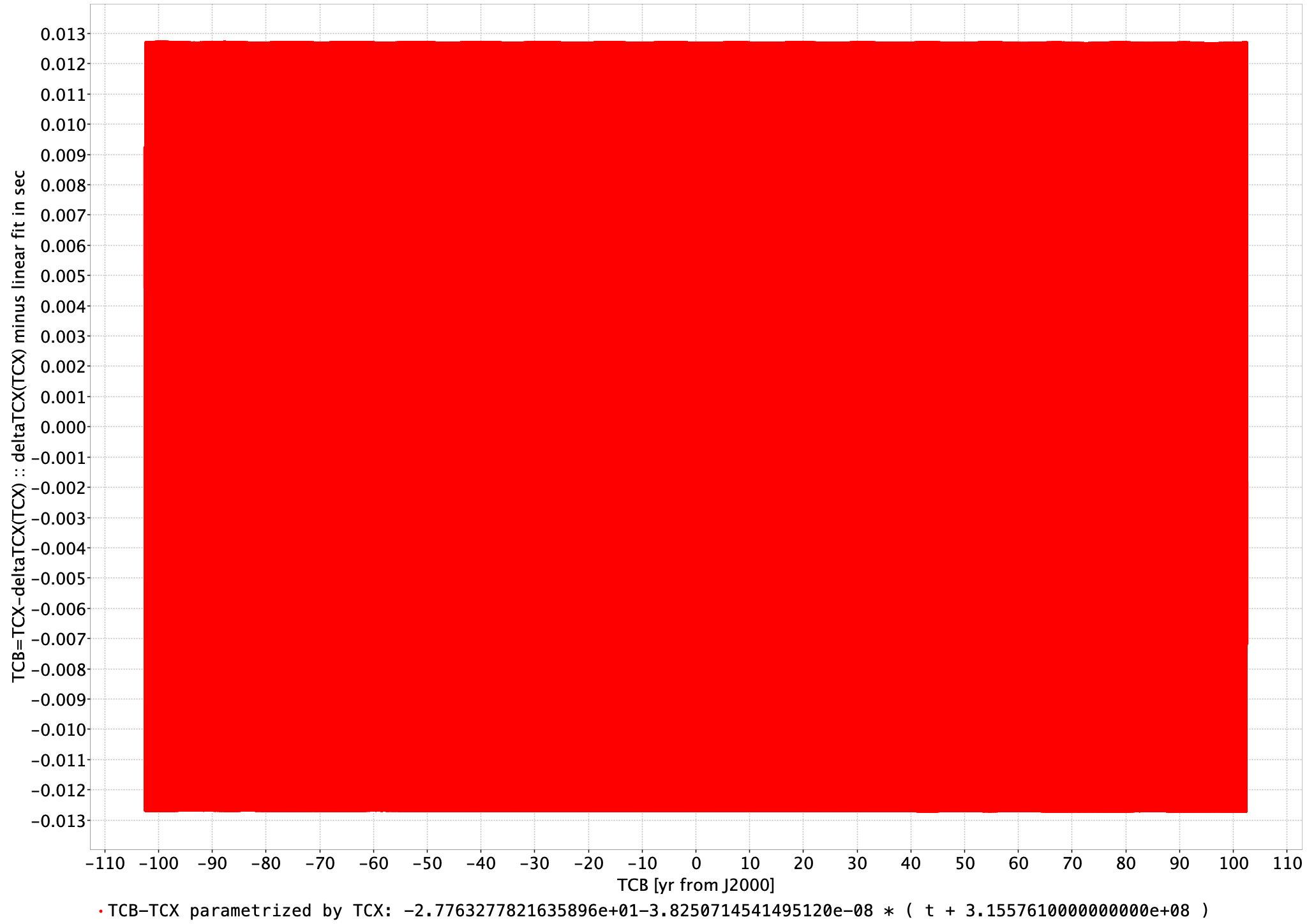
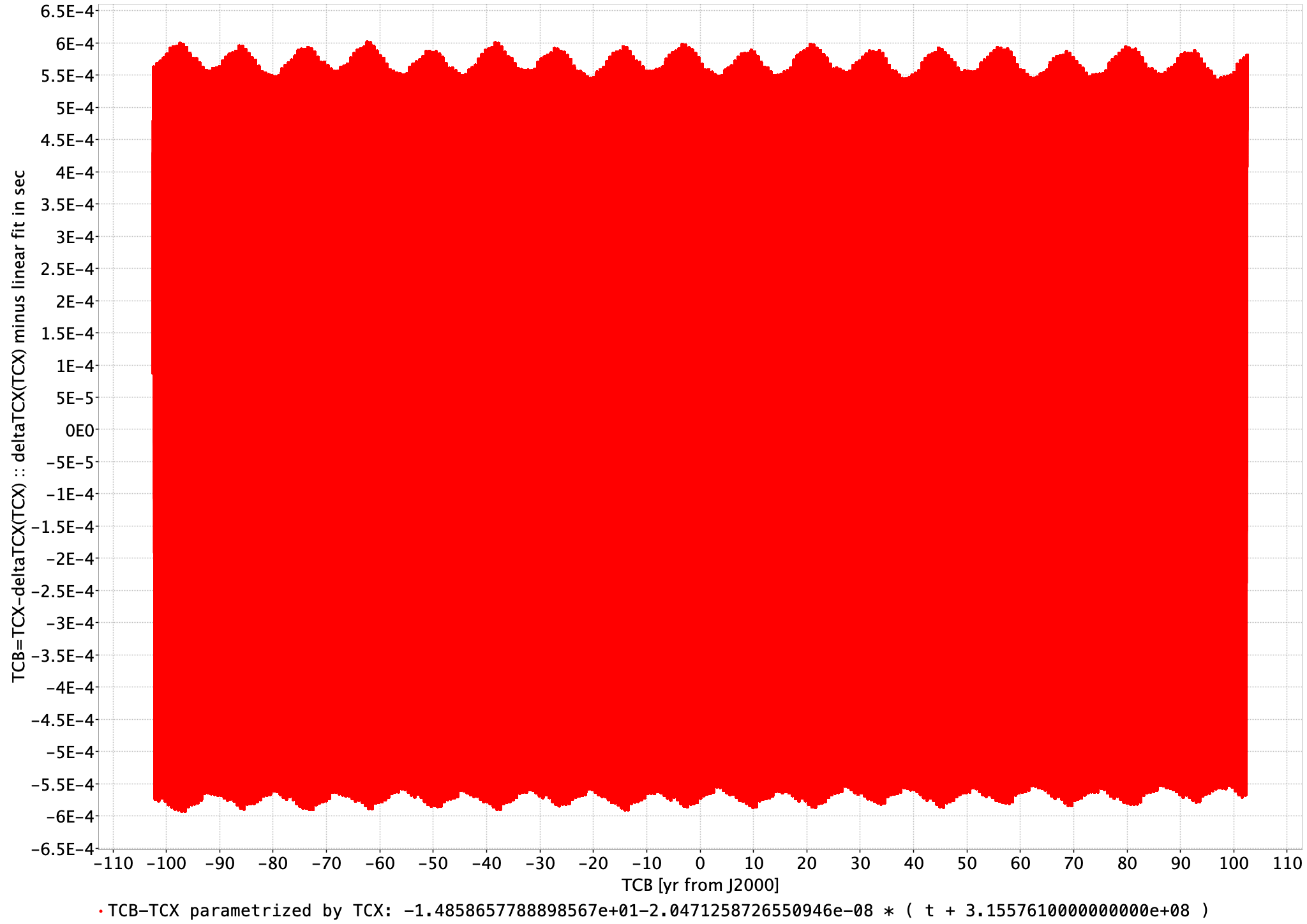
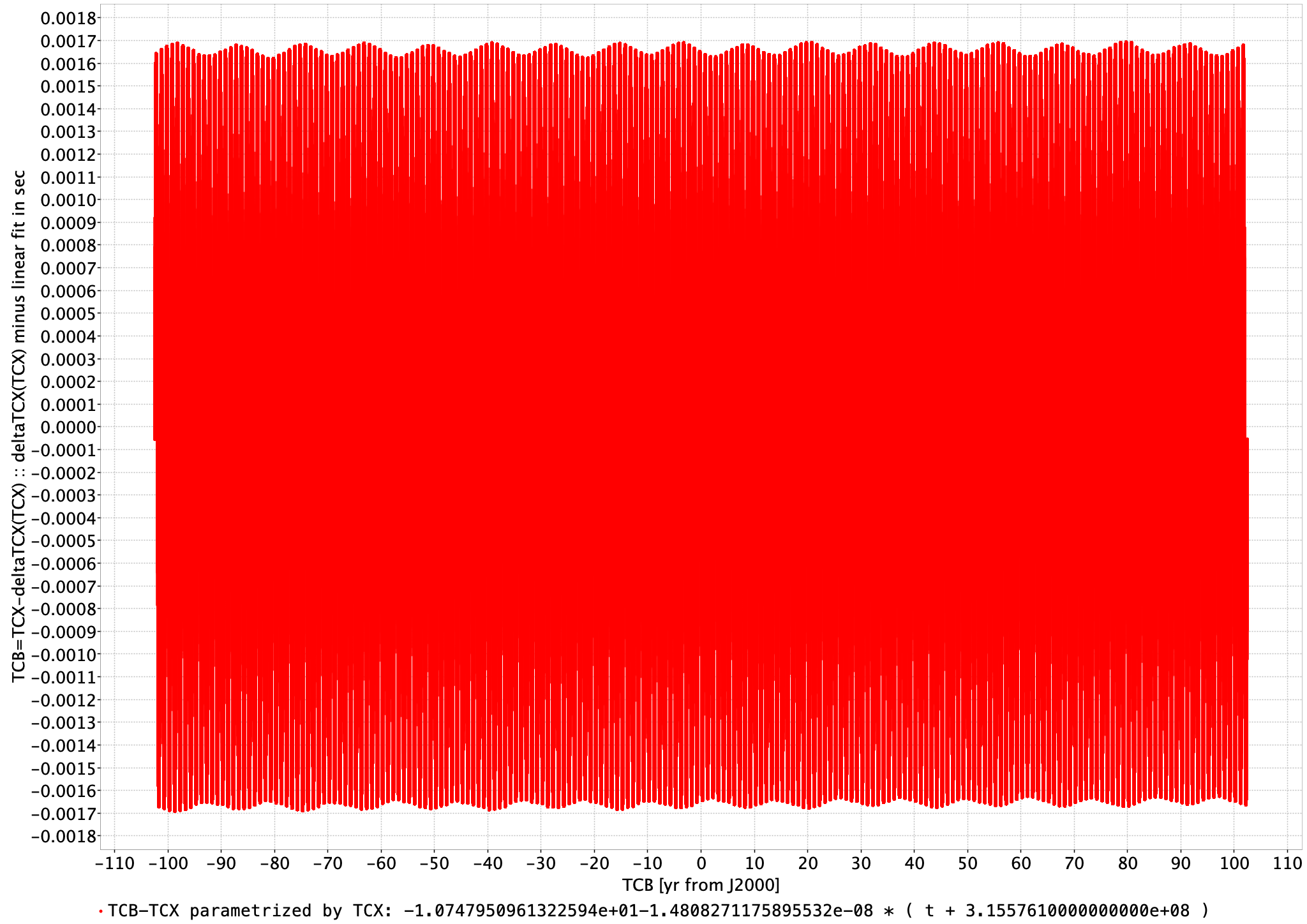
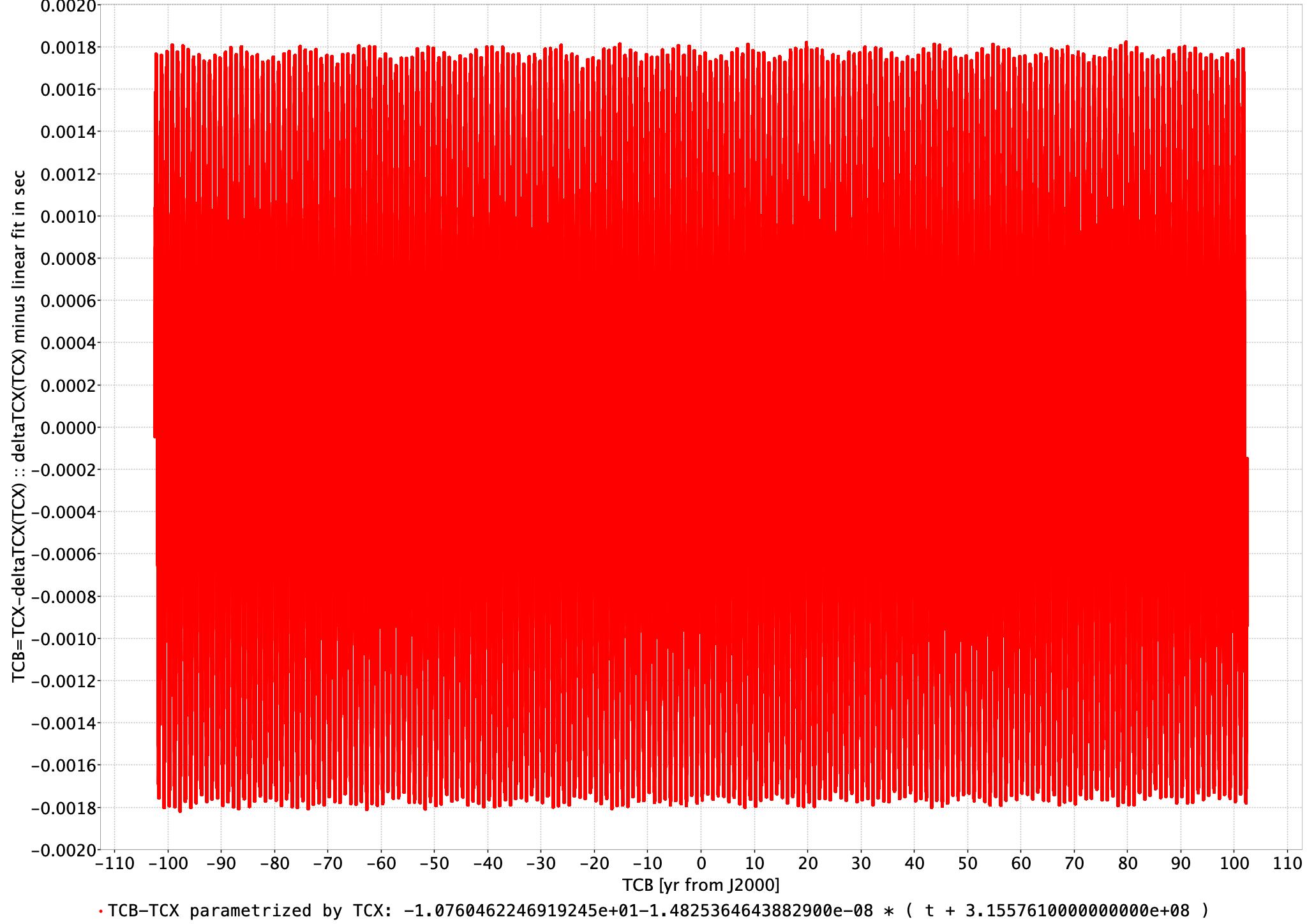
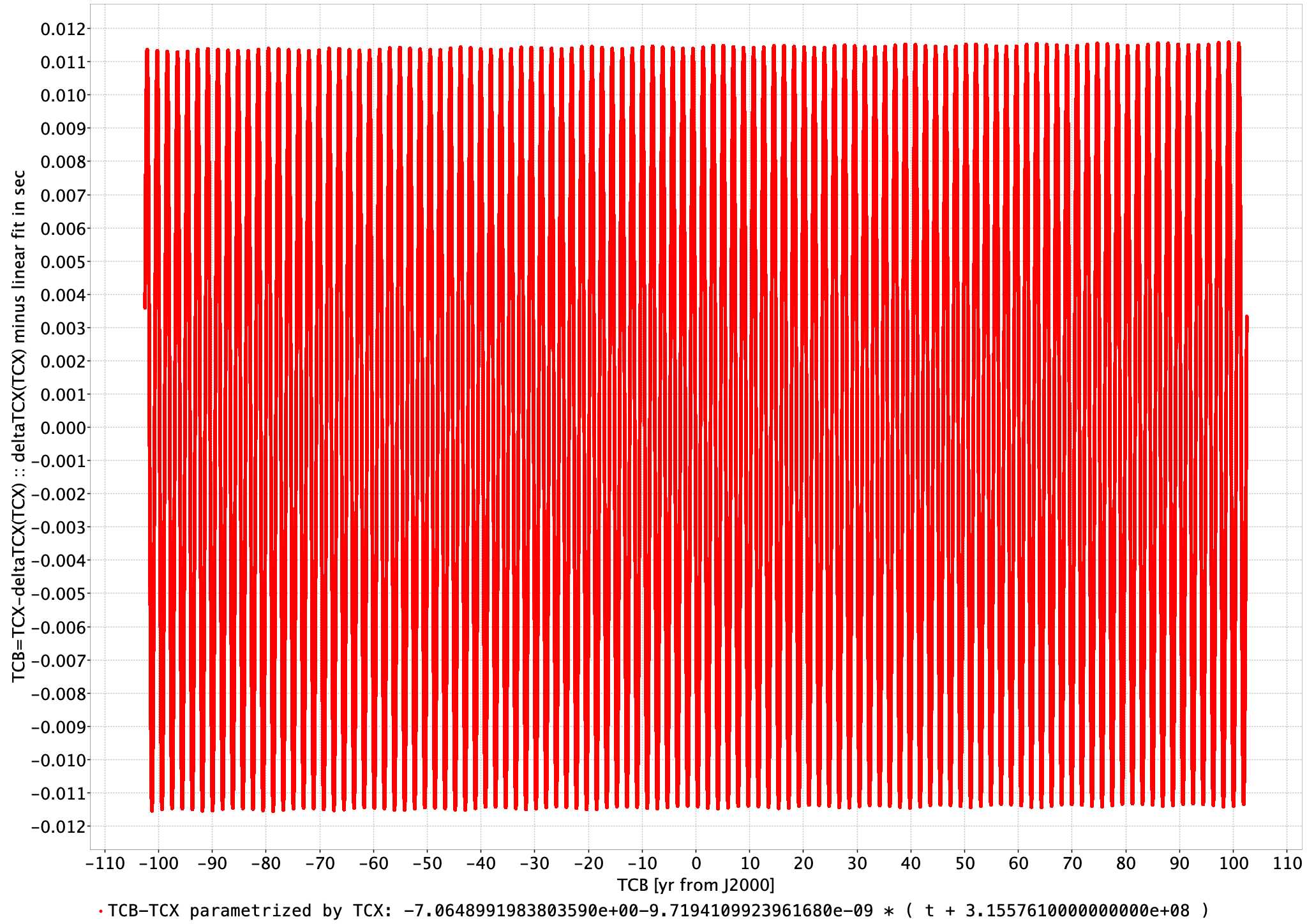
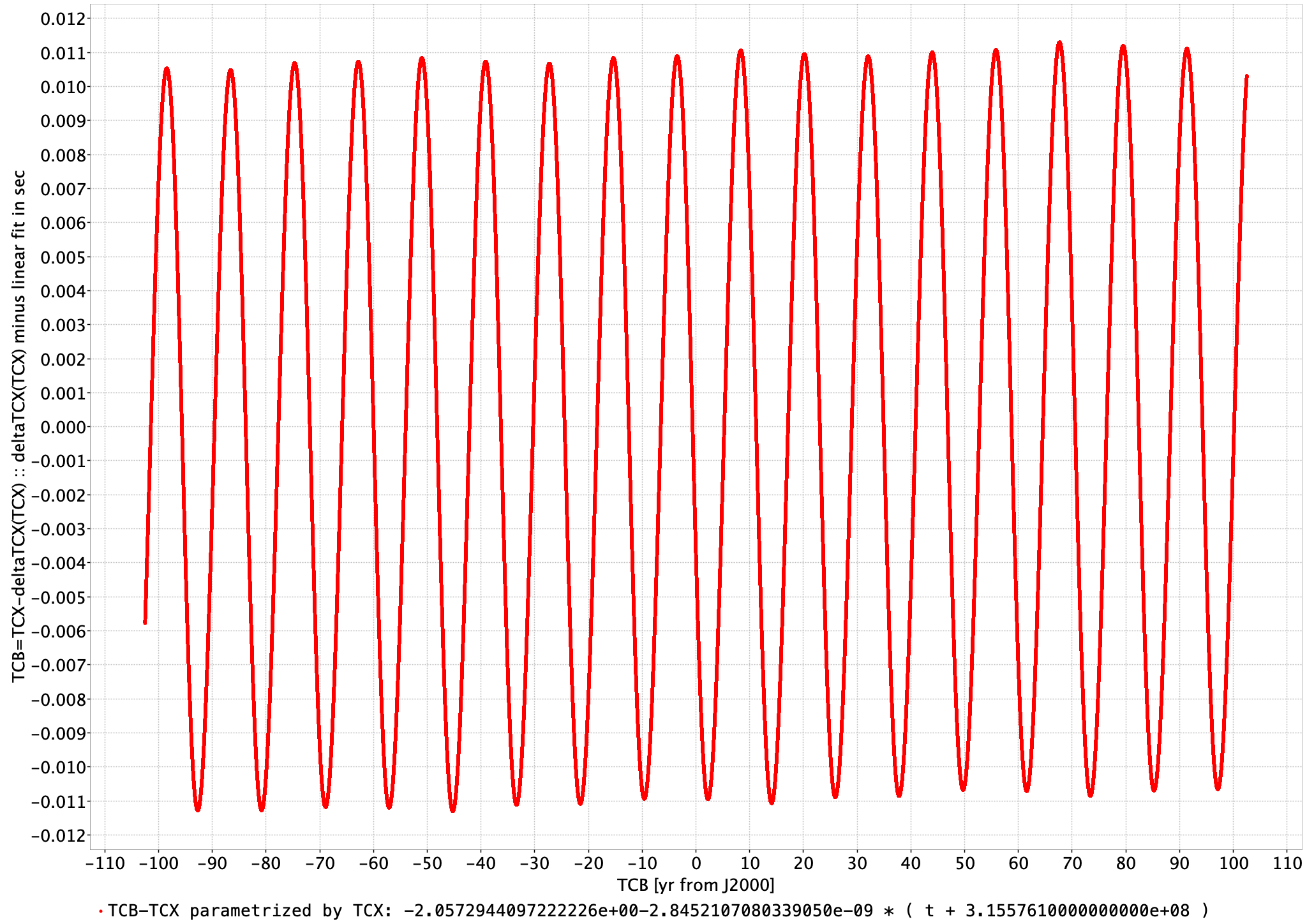
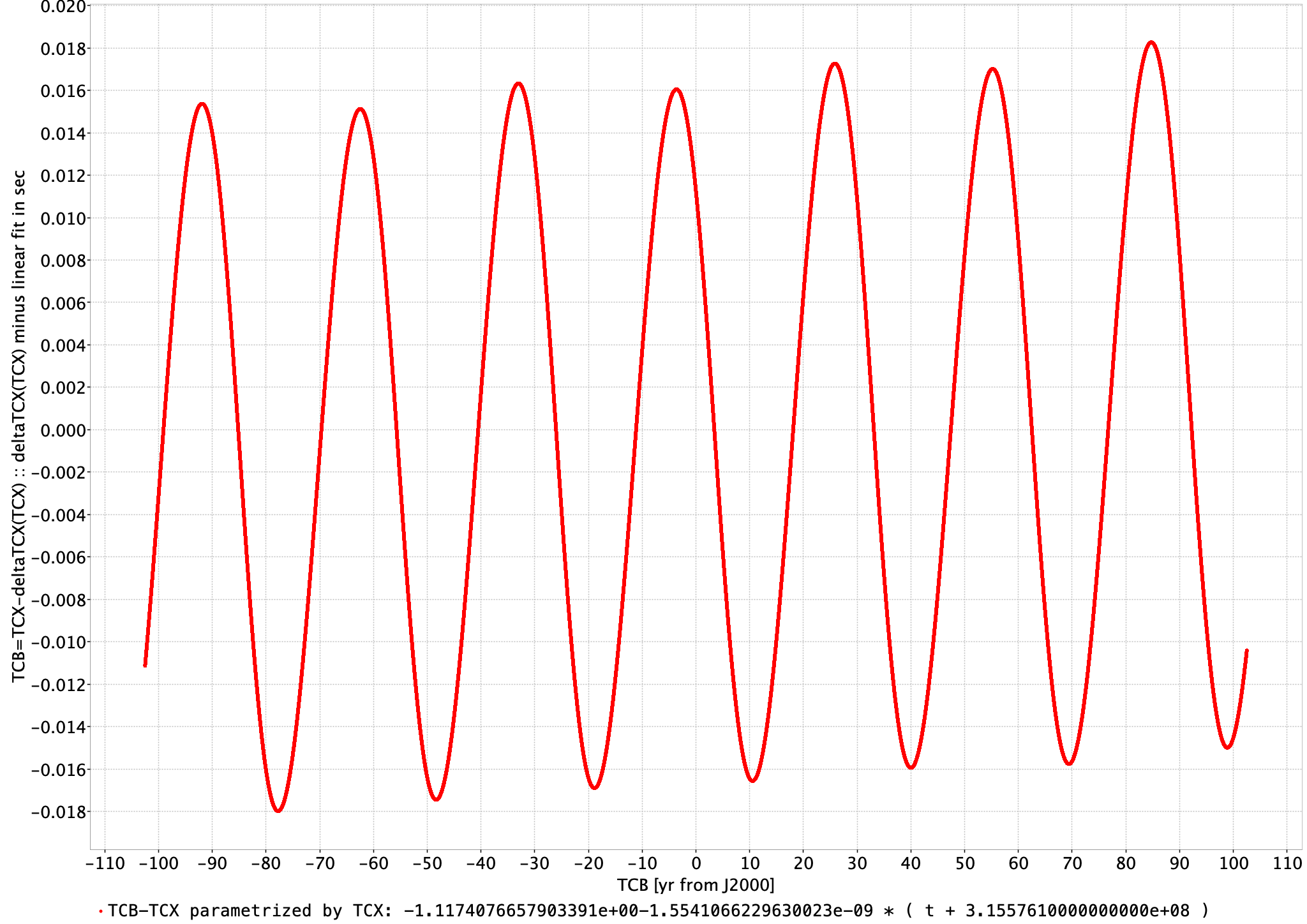
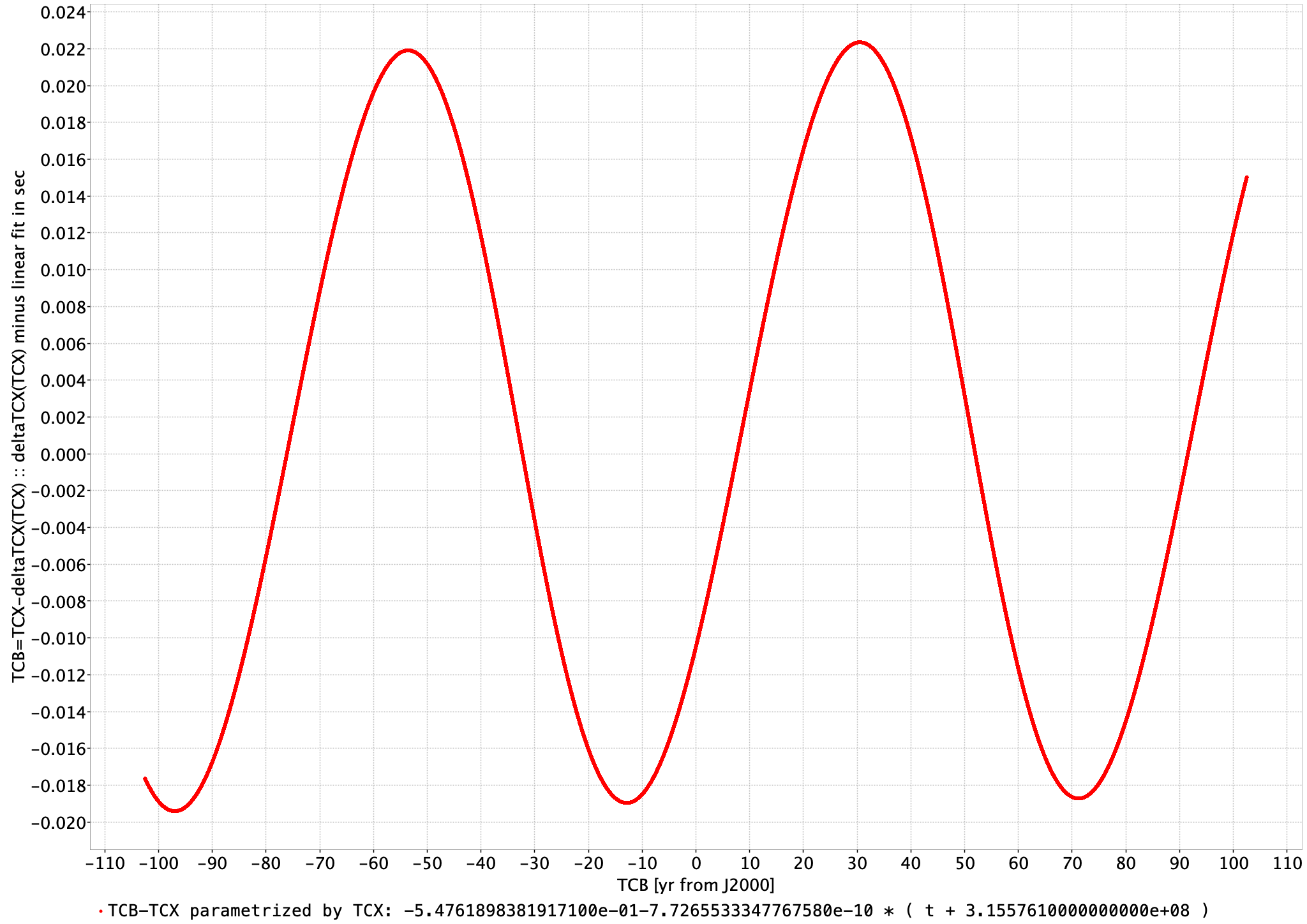
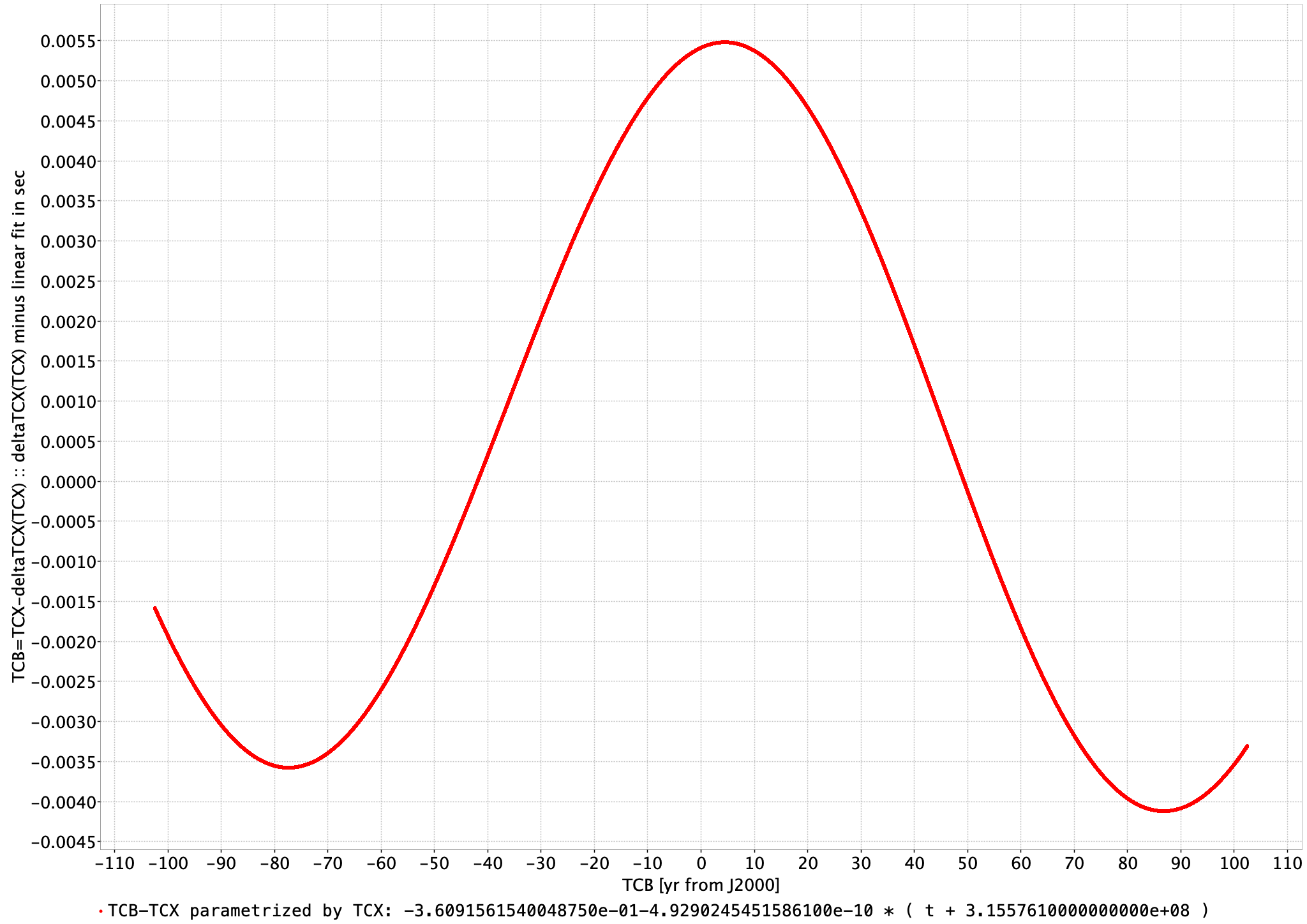
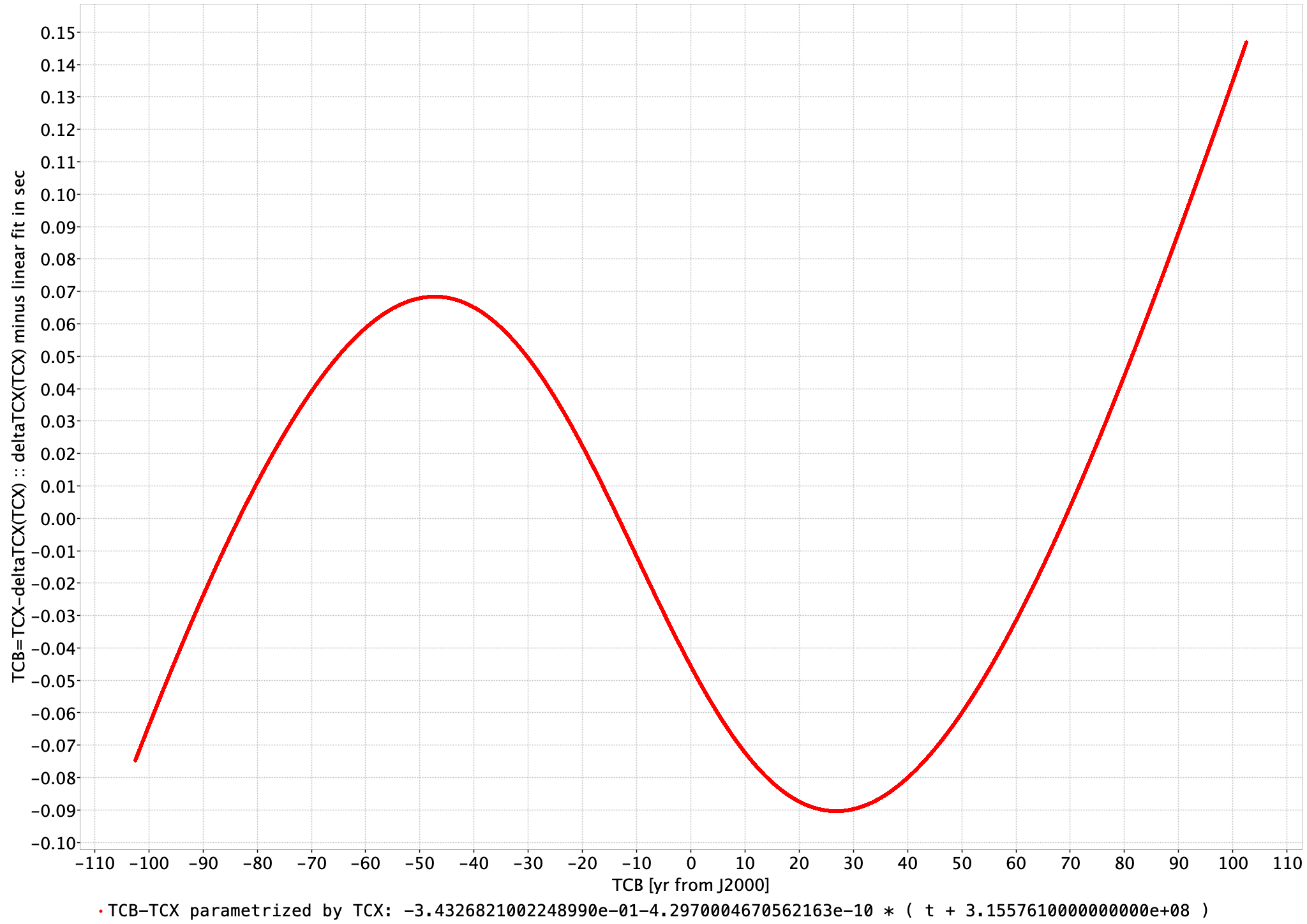
| body | notation | time ephemeris file | plot |
| Sun | TCSun | tcx19a_TCSun_m100_p100_asc_pos_TCB.asc | deltaTCB-Sun.png |
| Mercury | TCMer | tcx19a_TCMer_m100_p100_asc_pos_TCB.asc | deltaTCB-Mer.png |
| Venus | TCVen | tcx19a_TCVen_m100_p100_asc_pos_TCB.asc | deltaTCB-Ven.png |
| Earth | TCG | tcx19a_TCG_m100_p100_asc_pos_TCB.asc | deltaTCB-G.png |
| Moon | TCL | tcx19a_TCL_m100_p100_asc_pos_TCB.asc | deltaTCB-L.png |
| Mars | TCMar | tcx19a_TCMar_m100_p100_asc_pos_TCB.asc | deltaTCB-Mar.png |
| Jupiter | TCJup | tcx19a_TCJup_m100_p100_asc_pos_TCB.asc | deltaTCB-Jup.png |
| Saturn | TCSat | tcx19a_TCSat_m100_p100_asc_pos_TCB.asc | deltaTCB-Sat.png |
| Uranus | TCUra | tcx19a_TCUra_m100_p100_asc_pos_TCB.asc | deltaTCB-Ura.png |
| Neptune | TCNep | tcx19a_TCNep_m100_p100_asc_pos_TCB.asc | deltaTCB-Nep.png |
| Pluto | TCPlu | tcx19a_TCPlu_m100_p100_asc_pos_TCB.asc | deltaTCB-Plu.png |
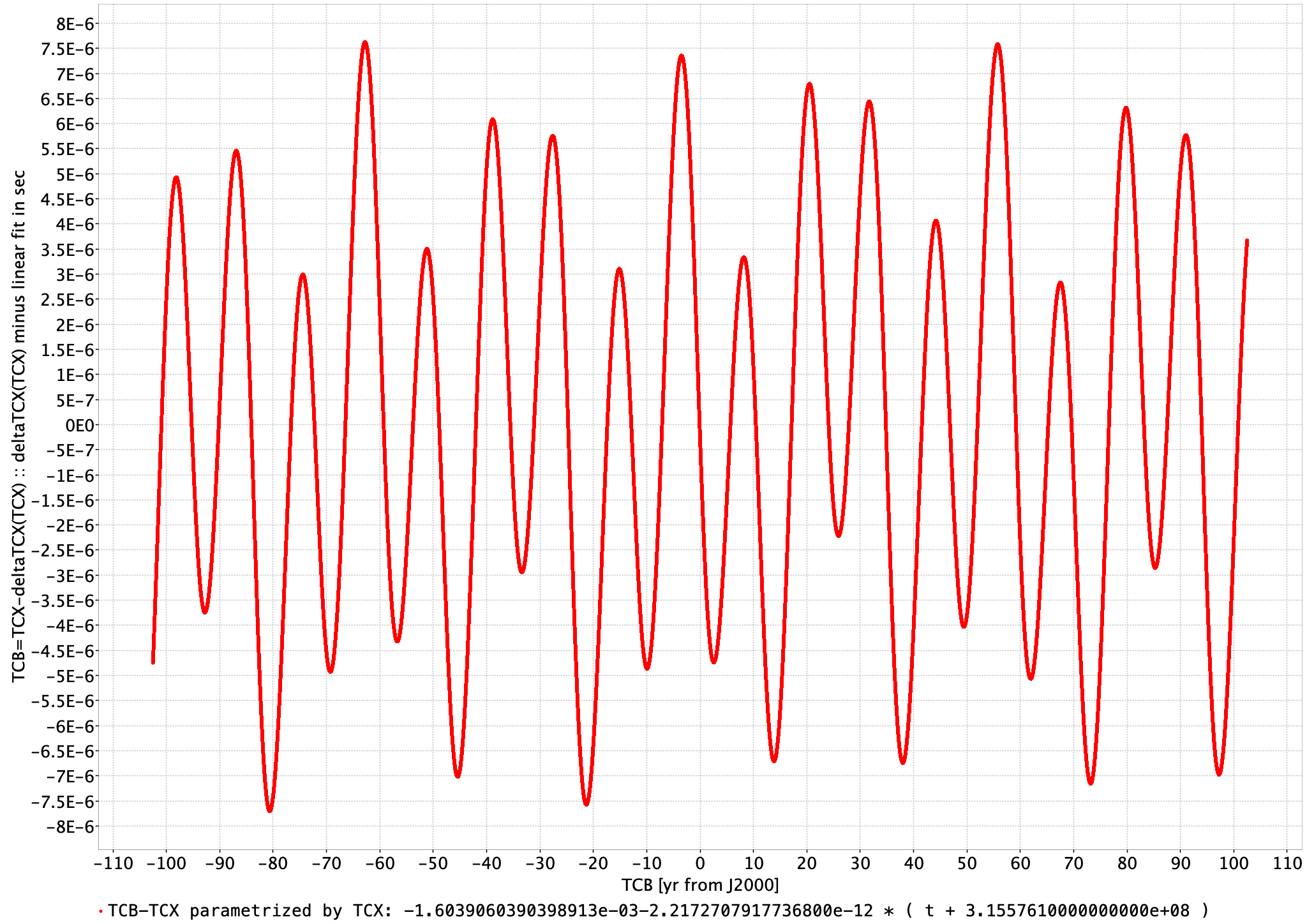
| body | notation | time ephemeris file | plot |
| Sun | TCSun | tcx19a_TCB_m100_p100_asc_pos_TCSun.asc | deltaTCSun.png |
| Mercury | TCMer | tcx19a_TCB_m100_p100_asc_pos_TCMer.asc | deltaTCMer.png |
| Venus | TCVen | tcx19a_TCB_m100_p100_asc_pos_TCVen.asc | deltaTCVen.png |
| Earth | TCG | tcx19a_TCB_m100_p100_asc_pos_TCG.asc | deltaTCG.png |
| Moon | TCL | tcx19a_TCB_m100_p100_asc_pos_TCL.asc | deltaTCL.png |
| Mars | TCMar | tcx19a_TCB_m100_p100_asc_pos_TCMar.asc | deltaTCMar.png |
| Jupiter | TCJup | tcx19a_TCB_m100_p100_asc_pos_TCJup.asc | deltaTCJup.png |
| Saturn | TCSat | tcx19a_TCB_m100_p100_asc_pos_TCSat.asc | deltaTCSat.png |
| Uranus | TCUra | tcx19a_TCB_m100_p100_asc_pos_TCUra.asc | deltaTCUra.png |
| Neptune | TCNep | tcx19a_TCB_m100_p100_asc_pos_TCNep.asc | deltaTCNep.png |
| Pluto | TCPlu | tcx19a_TCB_m100_p100_asc_pos_TCPlu.asc | deltaTCPlu.png |